


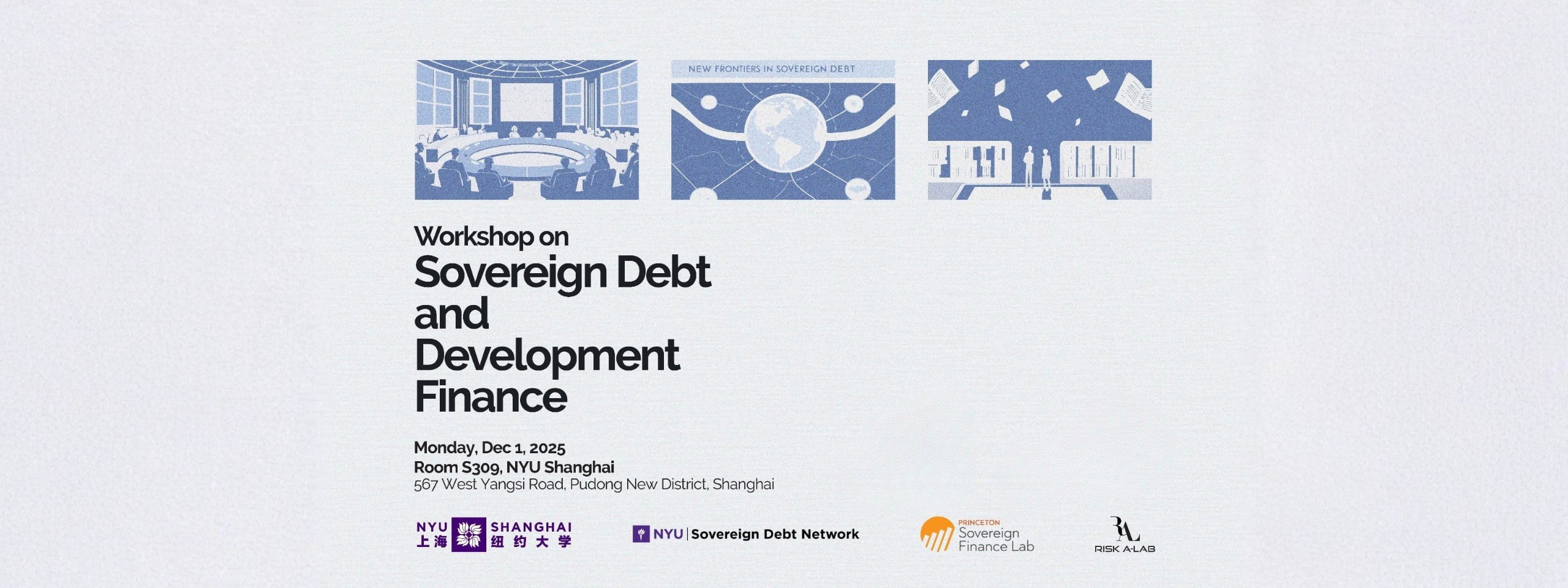
On December 1, NYU Shanghai hosted the Workshop on Sovereign Debt and Development Finance, organized by Assistant Professor of Political Science Jing Qian with support from the NYU Sovereign Debt Network, the Princeton Sovereign Finance Lab, and the PKU Analytics Lab for Global Risk Politics. Sponsored by the NYU Fund for Research on China (PI: B. Peter Rosendorff), the workshop brought together leading scholars and practitioners from New York University, Princeton University, Peking University, the Asian Infrastructure Investment Bank, the New Development Bank, Fudan University, Shanghai Jiao Tong University, Cornell University, Keio University, and beyond.
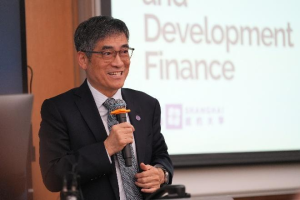
The event opened with welcome remarks from Chancellor Shijun Tong, who emphasized NYU Shanghai’ mission to foster global dialogue, interdisciplinary exchange, and collaboration across academia, policy, and practice. He highlighted the importance of creating platforms where diverse perspectives can meet, and expressed support for the workshop’s role in advancing NYU Shanghai’s engagement with urgent issues in global governance.
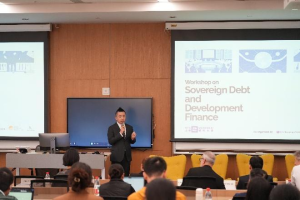
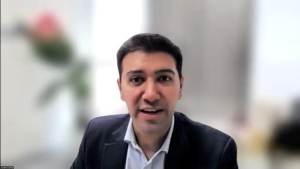
The one-day workshop began with a roundtable on “Sovereign Debt and Development Finance in a Changing Landscape”, which opened with a virtual contribution from Sidharth Kamani, Principal Professional at the New Development Bank, who outlined how development banks approach long-term lending, emphasizing asset quality, borrower capacity, and the need for lenders to remain engaged through economic cycles.
Han-Shen Lin, Associate Professor of Practice in Finance at NYU Shanghai and China Senior Advisor at The Asia Group, drew from his extensive banking experience to discuss how multilateral lending intersects with commercial credit practices, highlighting the “5Cs” of credit and raising concerns about transparency and risk management in China’s evolving overseas lending.
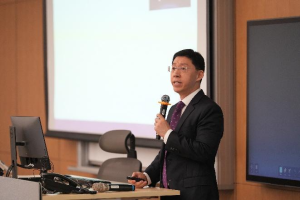
Representing the MDB perspective, Marcin Sasin, Head of Macroeconomics at the Asian Infrastructure Investment Bank, presented AIIB’s four thematic priorities—green, cross-border connectivity, digital infrastructure, and private capital mobilization—and mentioned that “there is no development without debt,” while urging attention to borrowers’ repayment capacity and the value of countercyclical support.
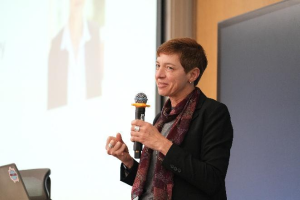
From the academic side, Layna Mosley, Professor at Princeton University and Director of the Princeton Sovereign Finance Lab, examined how domestic politics shape sovereign borrowing decisions, the changing creditor landscape—including expanded Chinese bilateral lending—and why understanding debt crises requires tracing the full life cycle of borrowing and restructuring.
Xun Pang, Professor of Political Science at Peking University and Director of the PKU Analytics Lab for Global Risk Politics, connected sovereign debt to broader systemic risks in critical raw material supply chains and emerging technologies, arguing that MDBs are increasingly drawn into stabilizing global risks that no single country can manage alone.
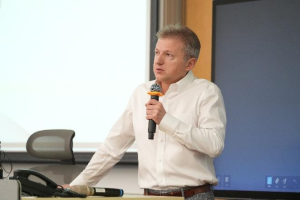
Finally, B. Peter Rosendorff, Professor at New York University and Director of the NYU Sovereign Debt Network, highlighted the rapid diversification of creditors and loan instruments—from collateralized resource-backed loans to new non-Paris Club lenders—and explained how this complexity contributes to the prolonged delays that now characterize sovereign debt restructurings.
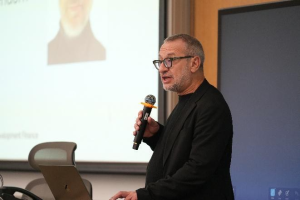

In the subsequent discussion, speakers converged on transparency as a core challenge in the current sovereign debt architecture. Participants debated why both creditors and borrowers have incentives to limit disclosure, how geopolitical competition complicates data sharing, and how emerging technologies—while promising greater openness—also introduce new risks such as misinformation. The conversation underscored that sovereign debt problems today stem not only from technical financial issues but also from political considerations on all sides, and that improving coordination and information flows among diverse creditors is essential to addressing future debt crises.
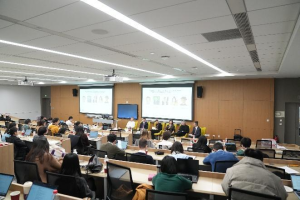
The afternoon research panel featured five papers offering fresh perspectives on sovereign lending, development finance, and international political economy.
Hongsong Liu (Shanghai Jiao Tong University) opened with “Outside Options, Vertex Centrality, and IMF Loan Conditionality.” Drawing on a new dataset of Regional Financial Arrangements and network centrality, the paper shows that countries embedded in stronger regional safety nets tend to secure more lenient IMF conditions, but high vertex centrality can weaken this bargaining power due to heightened contagion risks.
Yulin Chen (Fudan University) followed with “Spatial Distribution of Chinese Developmental Finance: Analysis Based on Texts from China’s Diplomatic Yearbook.” Using sentiment analysis to measure political alignment, he finds that China allocates high-concessional ODA to its closest diplomatic partners, while channeling lower-concessional, more commercialized finance toward hedging or “swing” states.
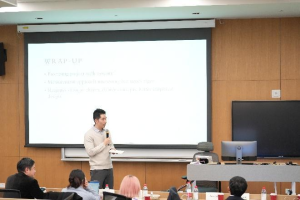
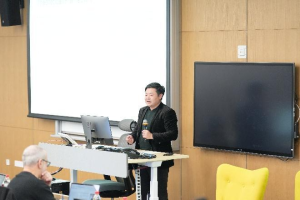
Yufan Huang (Cornell University) presented “Socialisation, Policy Opportunity, and Bureaucratic Bargaining: Explaining China’s Zig-zag Engagement with Multilateral Debt Restructuring.” Based on extensive elite interviews and process-tracing, the paper shows how uneven bureaucratic socialization within the Chinese state apparatus and shifting policy windows produce China’s inconsistent participation in G20–Paris Club debt restructuring initiatives.
Fangyuan Yi (Keio University) introduced “The Insulated Local Currency Sovereign Risk,” demonstrating that local-currency sovereign spreads in emerging markets behave differently from foreign-currency spreads: they remain surprisingly insulated from global risk cycles and show limited sensitivity to rising foreign investor participation, challenging dominant assumptions in sovereign risk pricing.
Xueying Zhang (Fudan University) concluded with “Crowd-in or Crowd-out? Major Donors’ Responses to U.S. Retrenchment in the Trump Era.” Using a donor–entity–year dataset across UN agencies, she shows that while other donors partly compensated for declining U.S. contributions—mainly through earmarked funding—core multilateral budgets remained underfunded, indicating only partial and temporary substitution.
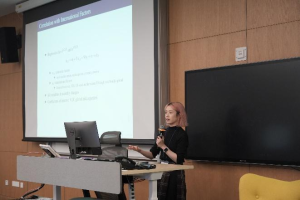
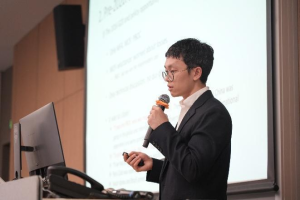
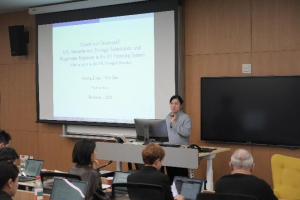
The panel benefited from constructive discussant comments by Layna Mosley, B. Peter Rosendorff和 Xun Pang, who connected the papers to broader debates on sovereign risk, creditor coordination, and the evolving role of major powers in global economic governance.
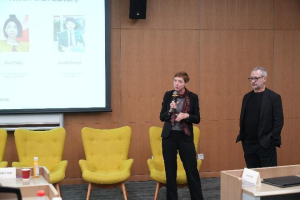
The workshop concluded with a richly informative Conversation with Editors featuring Layna Mosley (Co-Editor-in-Chief, International Organization), B. Peter Rosendorff (Associate Editor, International Organization), Xun Pang (Associate Editor, Political Analysis), and Jacob Dreyer (Senior Editor, Palgrave Macmillan). Together, they offered a rare, transparent look into the publication process across leading journals and academic presses.
Layna Mosley 和 Peter Rosendorff discussed the editorial expectations at International Organization, emphasizing the importance of clear theoretical contribution, rigorous empirical validation, and polished presentation. They stressed that IO receives far more promising papers than it can accept, making well-articulated research questions, strong framing, and a compelling narrative essential for competitiveness.
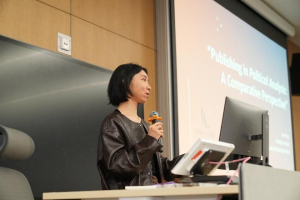
Xun Pang provided an inside perspective on publishing in Political Analysis, highlighting how methodological journals differ from substantive IR outlets in both expectations and evaluation criteria. She outlined article types (Research Articles and Letters), the single-blind review process, strict replication requirements, and recent policies on the use of AI tools. Prof. Pang also contrasted publication prospects in methods journals versus International Organization, noting that contributions to PA must show methodological innovation or clear inferential value.
Jacob Dreyer introduced the book-publishing process at Palgrave Macmillan, describing how the press supports Chinese and international scholars seeking to reach a global English-language audience. He walked participants through proposal preparation, peer review, contracting, and production, emphasizing Palgrave’s commitment to minimizing administrative burden and fostering cross-cultural scholarly exchange.
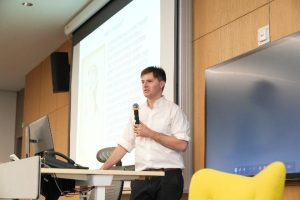
The session closed with an open Q&A, during which editors offered practical advice on positioning manuscripts, navigating revise-and-resubmit decisions, managing desk rejections, and developing book projects—providing attendees with concrete, field-spanning guidance for advancing their research toward publication.
The workshop concluded with a lively and engaged discussion among speakers and participants, reflecting the strong interdisciplinary and cross-sector interest in the political economy of sovereign debt and development finance. By convening scholars, practitioners, and editors from leading institutions, the event fostered meaningful intellectual exchange and highlighted NYU Shanghai’s growing role as a platform for dialogue on global economic governance. The organizers look forward to building on this momentum and continuing to facilitate conversations that bridge research and policy.
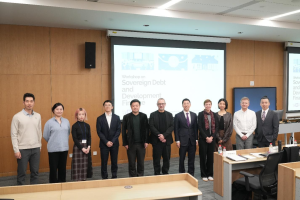
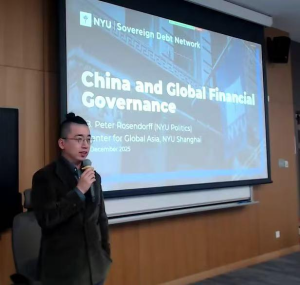
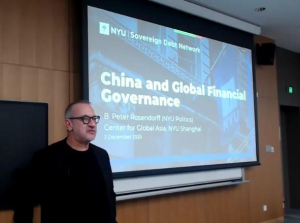
The following day, on December 2, NYU Shanghai’s Center for Global Asia extended these conversations by hosting a CGA Lecture Series talk by Prof. B. Peter Rosendorff (NYU), titled “China and Global Financial Governance.” Introduced by Jing Qian, Assistant Professor of Political Science at NYU Shanghai and Affiliated Faculty of the Center for Global Asia, the lecture drew on Prof. Rosendorff’s recent research and decades of work at the intersection of international political economy and global institutions. He examined how China’s expanding role as both a bilateral and multilateral lender is reshaping global financial governance, the incentives behind China’s lending practices, and the challenges of creditor coordination in an increasingly diversified landscape. The lecture offered a broader analytical frame for understanding many of the issues raised during the workshop and underscored the Center for Global Asia’s mission to situate contemporary policy debates within wider regional and global contexts. Together, the workshop and the CGA Lecture Series event highlighted NYU Shanghai’s expanding contributions to global conversations on financial governance, development, and international cooperation.
*Written by Jing Qian, with event notes provided by Lily Blair and Lilly Gessner,
and photography by Zhixing (Ken) Zhang.